adaption
T-Bone & London Bridge Station, work #2
Two films made a month apart are shown side by side. The first records London Bridge Station in the early morning of 9 October 2013. The second follows T-Bone playing and barking in Hackney Downs, London, on 12 November 2013.
In the station, the camera remains still, allowing the empty space and its architecture to occupy the frame. In the park, the camera moves to follow the dog. What links the two films is adaption: the way the camera responds to the different situations it encounters.
The contrast is not simply between a built environment and a natural setting, or between emptiness and activity. It also comes from two different acts of looking. One film observes from a fixed position; the other is shaped by an unfolding encounter.
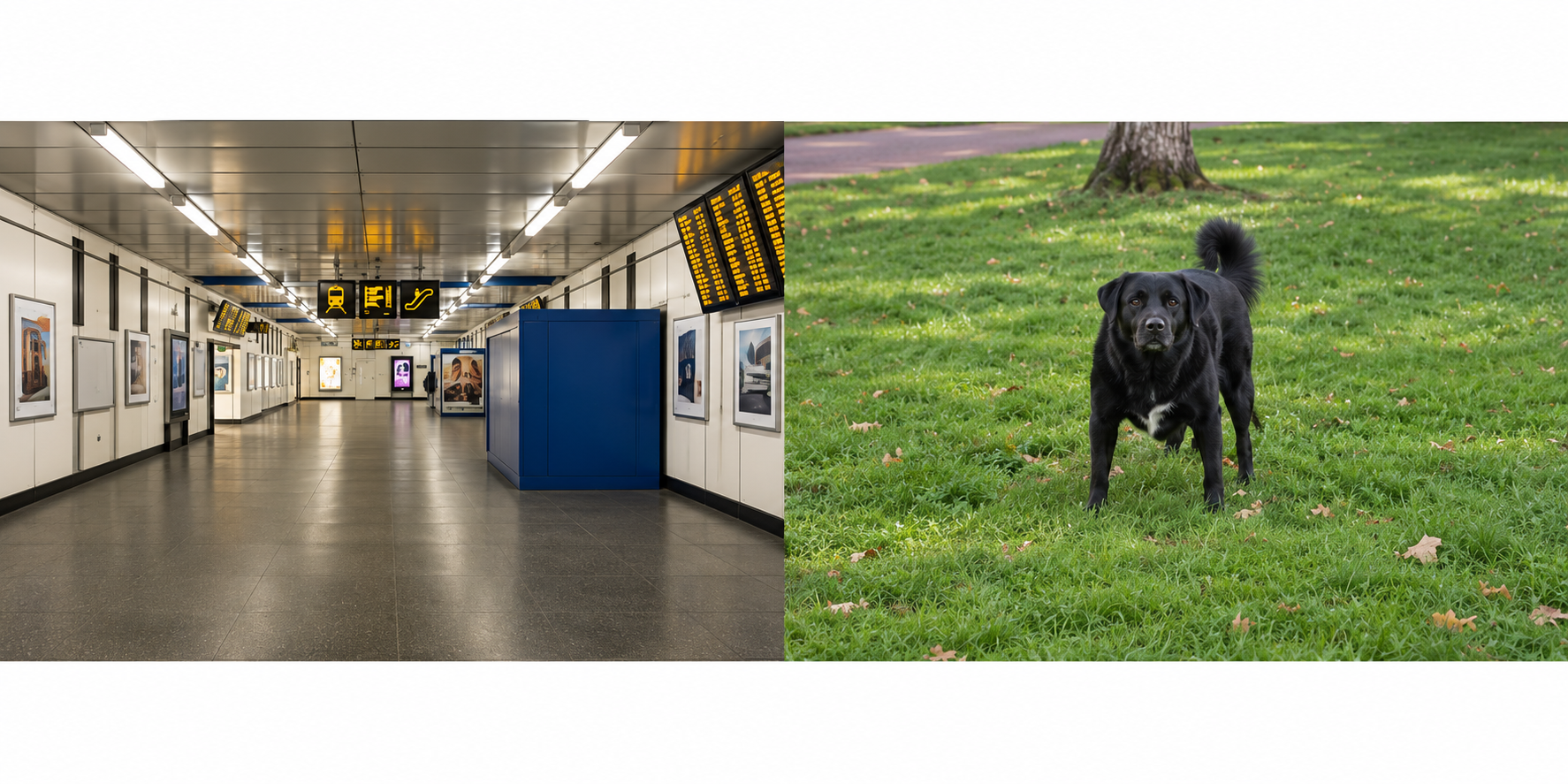
Video
Mode of display
Two projections, side by side, in a darkened room. Both films are shown without sound. Although their original soundscapes differ, removing the audio draws attention to the relationship between movement, stillness and the camera's position.
Background notes
In developing the work, I compared several aspects of the two settings. These are starting points for looking, rather than fixed categories or a complete explanation of the films.
London Bridge Station
- Camera remains still.
- Relatively empty space, with little human interaction.
- Architectural geometry and artificial lighting.
- A sense of waiting, distance and prolonged observation.
- Attention directed toward the surroundings rather than a central subject.
T-Bone in Hackney Downs
- Camera follows the dog's movements.
- Constant activity, play and interaction.
- Grass, daylight and irregular natural forms.
- A sense of energy, response and changing attention.
- Filming becomes part of an encounter with the dog.
The films invite oppositions such as stillness and movement, isolation and interaction, passive observation and active response. Yet these distinctions are not absolute: the station is not entirely inactive and the park is not free of human structures. What matters is how the camera adapts to each place and what that shift makes visible.